Shift At Midnight Emotion Detector
The tool that tells you what a customer is feeling has no name the developer has ever published. Players reached for two — emotion detector and emotion reader — and the guides picked one of them. This page sets out what the tool does, which parts of that are checkable, and which parts are one source repeated.
What it does
The account is consistent everywhere it appears: you point the tool at a customer and it reports what that customer is feeling right now. The readings are ordinary most of the time — happy, sad, the register of moods a person walking into a shop at night would plausibly be in.
Then occasionally one comes back that no person would produce. The hands-on guide with the most detail on this gives craving human flesh as its example, and that is the whole value of the tool. It does not grade suspicion. It occasionally hands you a reading that ends the question, and the rest of the time it hands you nothing you can act on alone.
Which is why every source that describes it lands on the same advice from different directions: run it on everyone, and never let it be the reason you pull the trigger. A calm reading is not a clearance. Humans are nervous at midnight, and something wearing a person is not necessarily nervous at all.
The developer has never named it
This is the part worth knowing before you trust any page about this tool, including this one.
Across all 27 posts on the game’s Steam news feed — from the singleplayer demo announcement on 28 June 2025 through the balancing patch on 29 July 2026 — the words emotion, detector, reader, anomaly, screener and scanner do not appear once. Not in a changelog, not in a feature announcement, not in the store description.
That silence is louder than it would be on most games, because this developer does name his systems. The Steam Next Fest demo changelog introduced eight of them by name in a single post — Vitals Monitoring, Inventory Management, Customer Variance, Performance Reviews, Uniform Customisation, the Spin Wheel, the Company Store and Expanded Jurisdiction out to the forecourt. A tool for reading a customer’s emotional state is a more interesting addition than a hat menu, and it is the one thing in the shop that never got written up.
The store description, repeated verbatim across a year of posts, names three checks and stops: examine their ID, cross-check their details in the computer, and observe their behaviour.
What the game has actually shown
Two screening interfaces appear in the developer’s own screenshots, and they are worth separating because guides routinely merge them.
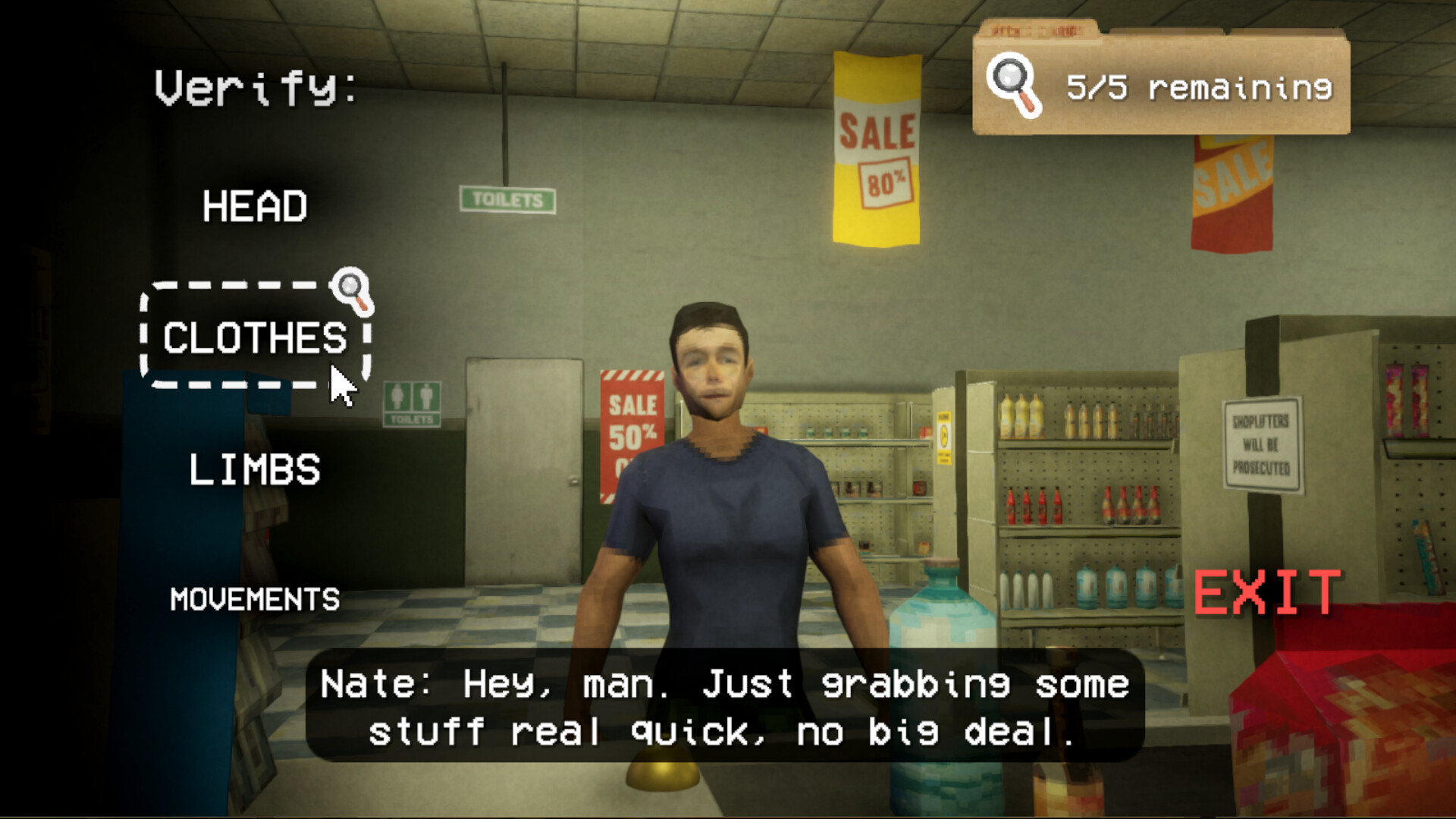
Verify splits a customer into head, clothes, limbs and movements, and caps how many you inspect — the counter in the corner of that screenshot reads five of five remaining. Question is a different screen with dialogue options on it, and it runs at the forecourt as well as the counter.
Neither carries an emotion readout. That does not mean the tool is not in the game; it means the two screens the developer chose to publish are not the one it lives on. The order these checks run in is where the emotion reading fits — after the ID and the database record have given you something for a reading to contradict, not before.
That sequencing is the one piece of advice all the guides share, and it is not arbitrary. An emotion means nothing until you have a story to measure it against, and the story comes from the record the store computer holds on each customer.
Where the sources disagree
Three things get stated confidently by pages that cannot show you why.
When you get it. One guide places it around the second night. No other source repeats it, no patch note mentions the tool, and the shipped game runs on randomly generated shifts — so a fixed night number is a claim, not a fact.
Where it sits. One description has it as a fixture on the counter. Another tells you to keep it by your side, which is how you describe something you carry. Both cannot be right, and neither shows a screenshot.
The five. Several guides describe a limit of five interrogation questions per customer. The five in the developer’s screenshot is on the Verify panel and counts inspections. There may well also be a question limit, but the number that can be pointed at belongs to the other screen.
There is one more thing worth recording because it comes from someone plainly describing their own play rather than writing a guide. A player working out which customers are fixed and which are randomised noted in passing that the definitive doppelgangers — the ones the emotion reader and the anomaly screener call outright — are among the fixed ones. If that holds, the tool is not sprinkling certainty at random across a run; a set number of customers are catchable this way and the rest are not.
We list it as one player’s observation, which is what it is. It appears four times in that thread only because it was quoted twice.
What would settle it
A screenshot of the tool with its label visible. That is the entire gap, and it is a smaller one than it looks — anyone with the game open closes it in a minute.
Until then, the honest position is that the emotion detector is real, well described, and unnamed by anybody who would know. Pages that hand you an official-sounding name for it, a fixed unlock night and a confident diagram are handing you three things they cannot show you, and the first of those is the one that will get quoted back at them.
Frequently asked questions
What is the emotion detector in Shift At Midnight?
A tool that reports what the customer in front of you is currently feeling. The readings run from ordinary moods like happy or sad through to ones no human would return — craving human flesh being the example a hands-on guide gives. An obviously inhuman reading is the clearest single tell in the game, which is why guides tell you to run it on everybody.
Is the emotion detector its real name?
Nobody outside the studio can say. The guides call it the emotion detector and that is the name people search. A player on Steam describing their own runs calls it the emotion reader instead, and pairs it with an anomaly screener. None of those four words appears in any developer post, so all of them are names players settled on because the game gave them none to use.
Does the emotion detector tell you who is a doppelganger?
Only sometimes, and only in one direction. A reading that no person could produce settles it. An ordinary reading settles nothing, because a nervous human returns one and a composed doppelganger can too. Every guide that describes the tool says the same thing in different words — it starts an investigation rather than ending one.
When do you get the emotion detector?
One guide says it appears around the second night. It cites nothing, no other source repeats it, and no patch note mentions the tool at all, so treat the timing as unverified. What is documented is that the shipped game runs on randomly generated shifts, which makes any fixed night number a claim worth checking before you plan around it.
How many checks do you get per customer?
Five, and that number is visible in the developer's own screenshot — the verification panel carries a counter reading five of five remaining. Note what it is counting. It caps the looks you take at a customer's head, clothes, limbs and movements. Guides that describe it as five interrogation questions are describing a different part of the screen.
Why is there no official information about the emotion detector?
Because the developer has never written about it. He posts detailed changelogs and names his systems in them, so the silence is unusual rather than routine. The store description names three checks — the ID, the computer record and the customer's behaviour — and the tool most naturally belongs inside the third, which may be why it never earned a line of its own.