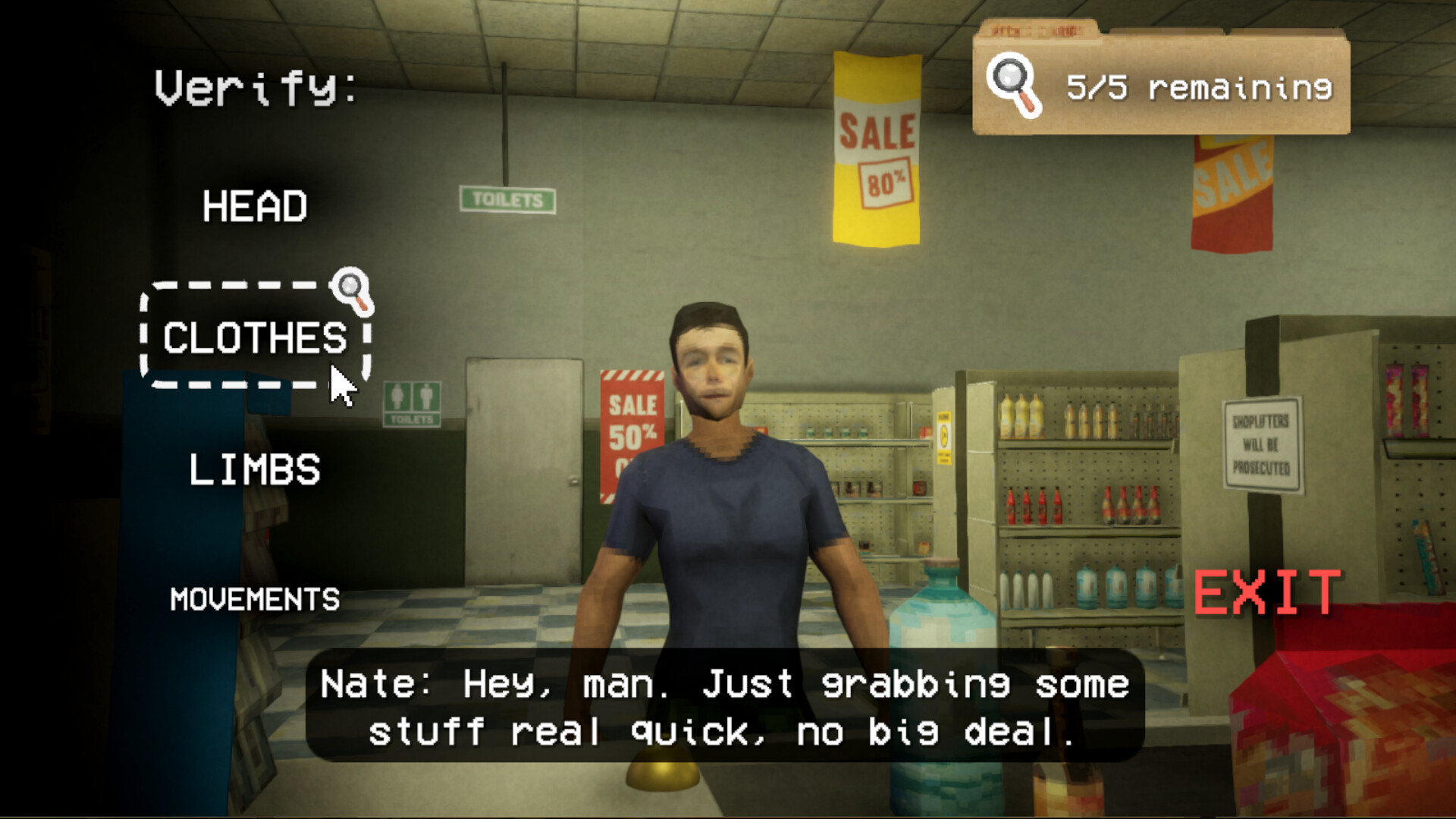
Shift At Midnight has two halves that get in each other's way. One is a shop that needs restocking, deliveries and a nightly quota. The other is a screening job where getting it wrong summons something at the end of the night. This reference covers both, plus the threats and modes that sit behind them.
Systems and threats
The register
Core systemWhere the game is decided. Pack the customer's items, scan their ID against the database, question them about the identity they are presenting, then either complete the sale or act on the conclusion that they are not human.
Shop duties
Competing systemRestocking shelves, receiving deliveries, cleaning, and meeting a nightly quota. Individually trivial, collectively the reason you are tempted to rush a screening — which is exactly what they are there for.
Creatures that impersonate specific named people already present in the customer database. Nine customers are confirmed to have impostor versions. A doppelganger that gets through leaves quietly and escalates the night rather than attacking on the spot.
The Entity
Escalation threatA spider-like being of abnormal size that arrives at the store at the end of a shift, summoned by a doppelganger you failed to catch. It is the delayed consequence of a bad call at the counter, not a random event.
Execution and cleanup
MechanicJudged impostors can be shot at the counter. A body shot sends them running and needs a follow-up; a headshot ends it immediately. What is left behind has to be cleaned up, which costs shift time you also owe the quota.
Barricading and hiding
Failure stateWhen the night turns against you, the game shifts from retail to survival — boarding up doors, setting traps and hiding rather than fighting.
The main campaign, running a fixed sequence of nights. Completing it unlocks the second mode.
Unlocked by finishing Story Mode. Unlimited nights with no completion condition — it ends when all players die.
Most of what is written about Shift At Midnight describes it as a horror game
with a shop attached. It is more accurate to say the shop is the horror
mechanic, because the shop is what stops you from doing the screening properly.
Where each thing is documented
Screening is where runs are won and lost, so the customer roster gets its own
page: the character list names the nine customers with confirmed
doppelganger versions, which is worth knowing before a shift rather than during
one. The walkthrough covers a night in the order it actually
happens — what to do before the first customer arrives, how to keep the quota
alive while somebody holds the register, and what the job becomes after a
positive call. The emotion detector has a page to itself
because most of what circulates about it is a single source repeated.
Behind the counter sits everything the screening is protecting you from.
The story page collects what the game actually establishes about the
doppelgangers, the Entity and the Calendar Killer, and how a run ends.
The Marionette is one of only three enemies the game names
anywhere in writing, and its page separates the one developer statement from
what players report. The achievements list all ten with their
global unlock rates, including the three that ship with a name and no
description at all.
The practical questions have their own pages. Where to play
covers the two storefronts, what each charges and why Game Pass changes the
answer. The demo is still on Steam after release, which is not what
usually happens to a demo. And if the game will not let you into a friend’s
lobby, troubleshooting has the developer’s own fix for that
one and is explicit about which of the remaining problems still have none.
The tension the game is built on
Nothing in the shop is hard. Shelves need refilling, deliveries need putting
away, the floor needs cleaning, and a quota needs hitting before the night ends.
Any one of those is a chore.
The screening is not hard either, taken alone. Scan an ID, look at the photo,
look at the person, ask some questions about who they claim to be. Players also
describe a tool that reads a customer’s emotional state, which the developer has
never written about — worth knowing, because most pages covering it state more
than they can show.
The game is the two at once. Every minute spent being careful at the register is
a minute the shelves are empty and the quota is slipping, and every minute spent
restocking is a customer processed faster than they should have been. There is no
setting where you can do both properly, and that is not a balance problem — it is
the entire design.
Why mistakes are invisible
The consequence structure is what separates this from most co-op horror.
Waving through a doppelganger produces no feedback. The transaction completes,
the customer leaves, the shift continues. What actually happened is that it went
and alerted the Entity, and the Entity comes at the end of the shift.
So the information you need to correct your behaviour arrives after the point
where correcting it is possible. You cannot learn from the mistake within the
run that contains it — only across runs, which is why knowing the confirmed
impostor roster in advance is worth more here than reflexes.
Both modes
Story Mode is the campaign and runs a fixed number of nights. Endless Mode
unlocks when you finish it and removes the ending entirely — nights continue
until every player is dead.
The distinction matters for how you play. In Story Mode a bad night is a setback
inside a structure that will end. In Endless Mode there is no structure to
outlast, so the screening discipline is the only thing keeping the run alive.
Neither mode is tied to a storefront. Both ship in the same build everywhere the
game is sold, so which platform you play on decides the price and the controller
rather than the content.