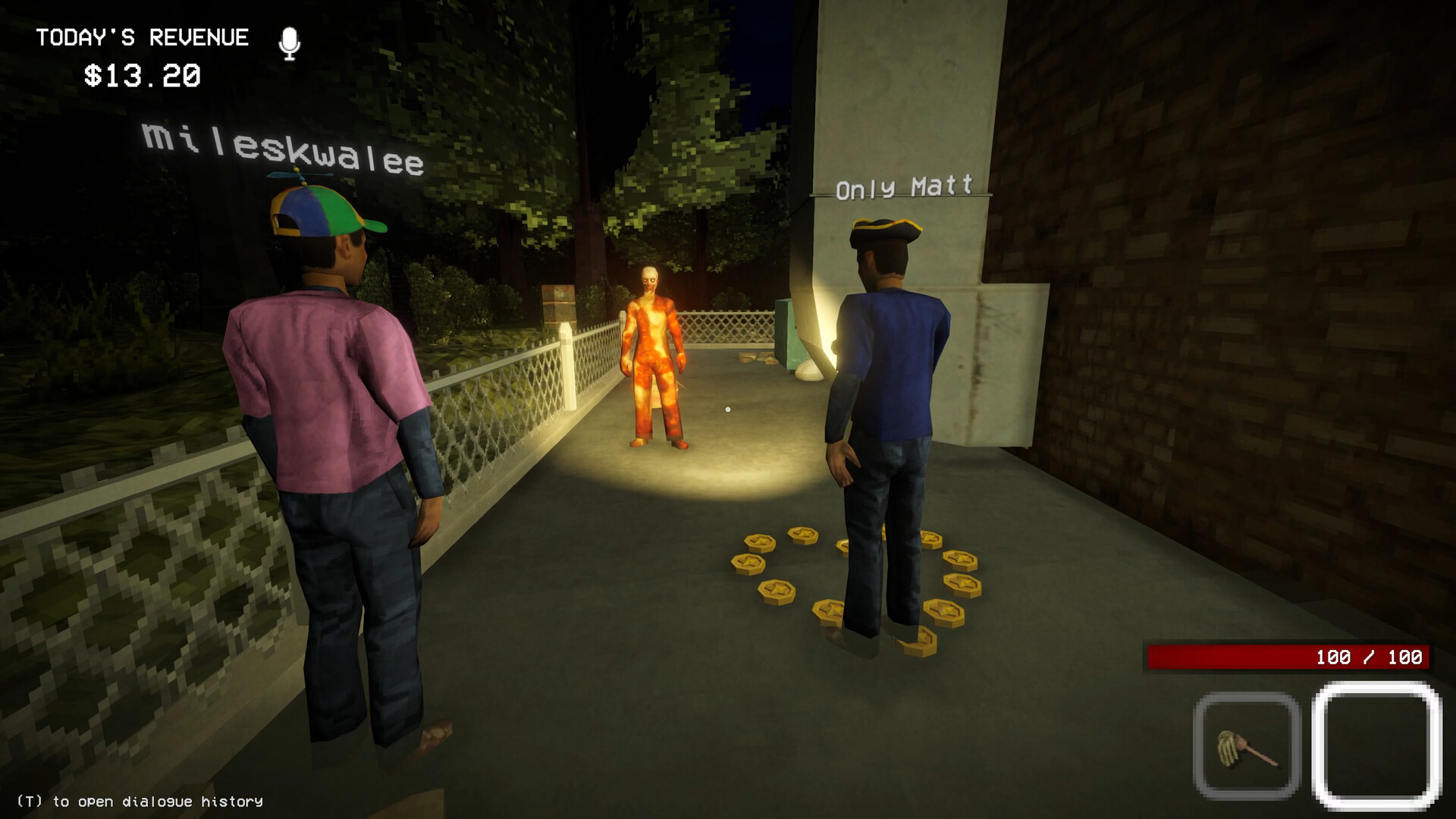
Shift At Midnight never sits you down and explains itself. The story arrives in pieces — a news item about a killer who works to a calendar, murals of something with too many legs, an organisation hunting creatures that wear other people's faces. This is what the game actually establishes, and what happens at the end of a run.
What the game establishes
The doppelgangers
Primary antagonistsCreatures of unknown origin that impersonate specific named people. They have spread through the population widely enough that organisations now exist to track and kill them, and they come into the store wearing identities that are on file in your own database.
The Entity
EscalationA spider-like being of abnormal size, and the consequence of failure rather than a random encounter. A doppelganger you fail to catch goes and alerts it, and it comes to the store at the end of the shift. Murals of it appear in the game's own artwork, implying something older than the gas station.
The Calendar Killer
Background narrativeA killer referenced in news reports who strikes on the eighth of each month and kills eight people, attacking across six consecutive months. In December the attacks stop, and the absence is treated as its own kind of news.
Story Mode
Main campaignThe primary game mode, running a fixed sequence of nights toward a conclusion. Finishing it is the unlock condition for Endless Mode.
Endless Mode
Post-campaign modeThe second of the game's two modes, unlocked by completing Story Mode. It has no night limit and ends only when all players are dead, which makes it the mode where the screening loop is tested rather than the narrative.
The premise the game gives you is small: work nights at a gas station, check
IDs. The story is what leaks in around the edges of that job.
What the doppelgangers are
The game is direct that nobody knows where they came from. What it does
establish is scale — they spread among people across the world, and the response
was organised. Special organisations now exist to track them down and kill them,
which is the context that explains why a gas station clerk has an ID scanner, a
customer database and a gun behind the counter.
They do not invent identities. Every doppelganger impersonates a specific real
person whose details are already in the database you are checking against. That
detail matters more than it first appears: it means the system you use to catch
them is the same system they use to get in. The people whose identities get worn
this way are the customers who come through the door.
The Entity
The Entity is where the game stops being a screening puzzle.
It is described as spider-like and abnormally large, and it is one of the main
antagonists — but it does not show up on a timer or a random roll. A doppelganger
that gets past your register goes and alerts it, and the Entity arrives at the
store at the end of that shift.
That chain is the game’s central piece of design. The punishment for a bad call
at the counter is not immediate, is not obviously connected to the customer you
waved through, and does not arrive until the night is nearly over. You find out
you were wrong at the point where it is too late to be right.
Murals of the Entity appear in the game’s artwork, which places it as something
that predates the store rather than something the doppelgangers summoned.
The Calendar Killer
Running underneath all of this is a news story the game never resolves. A killer
strikes on the eighth of every month and kills eight people, and has done so
across six consecutive months. Before each attack a news article goes out and
residents are told to stay indoors and limit outdoor activity.
Then December comes and nothing happens, and the town starts wondering where
they went.
The Calendar Killer is mentioned, not fought. Whether the pattern connects to the
doppelgangers or to the Entity is left where the game leaves it.
How a run ends
Shift At Midnight has multiple endings rather than one conclusion. A run
resolves according to how the shift goes — whether you survive the night, and
whether anything you let through comes back to collect.
Steam’s achievement list is the only public confirmation that the game grades
those resolutions differently. One of the ten is called True Ending and is held
by 15.6% of owners; two more are hidden with no description published at all.
That is the whole of what can be sourced, and
the achievement list and what it settles is worth reading
before trusting any page that maps the endings out in detail.
Completing Story Mode unlocks Endless Mode, which drops the narrative frame
entirely: unlimited nights, no ending condition except every player dying. It is
the mode that exists once you already know what the endings are, and
how the two modes differ in practice matters more to how you play than
the narrative frame does.
Frequently asked questions
Does Shift At Midnight have a story mode?
Yes. Story Mode is the main campaign and runs for a fixed sequence of nights. Completing it unlocks Endless Mode, which runs indefinitely and only ends when every player is dead.
How many endings does Shift At Midnight have?
The game has multiple endings rather than a single fixed conclusion. Which one you reach depends on how your run resolves — whether the shift is survived, and whether anything got past you along the way.
What is the Entity in Shift At Midnight?
A spider-like creature of abnormal size, and one of the game's main antagonists. It does not wander in on its own — a doppelganger that escapes your register goes and alerts it, and the Entity arrives at the store at the end of that shift.
Who is the Calendar Killer?
A serial killer referenced through in-game news, said to strike on the eighth of each month and kill eight people. Reports place attacks across six consecutive months, then nothing in December, which the town notices. The killer is mentioned rather than encountered.
What happens if a doppelganger escapes?
Nothing at the counter, which is the trap. It leaves with the other customers and alerts the Entity, and the consequence lands at the end of the shift instead of the moment you made the mistake.